
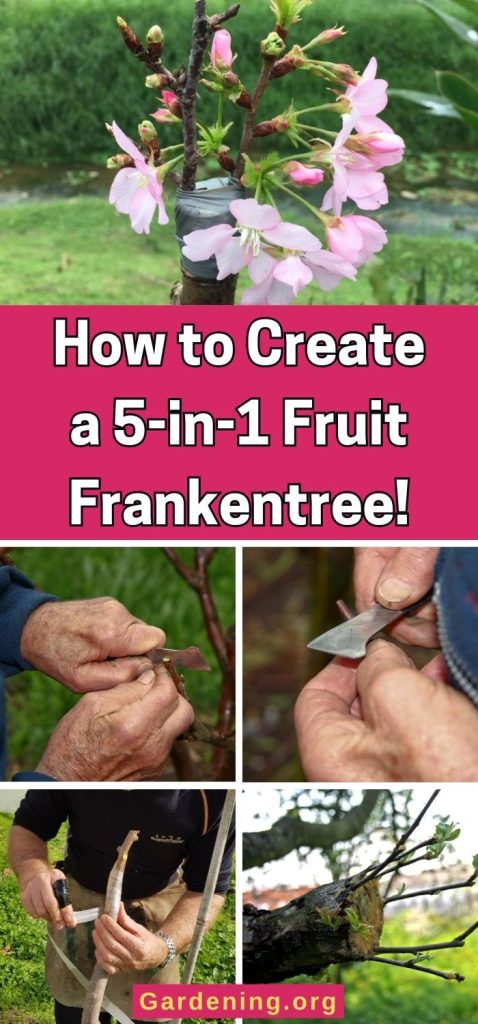
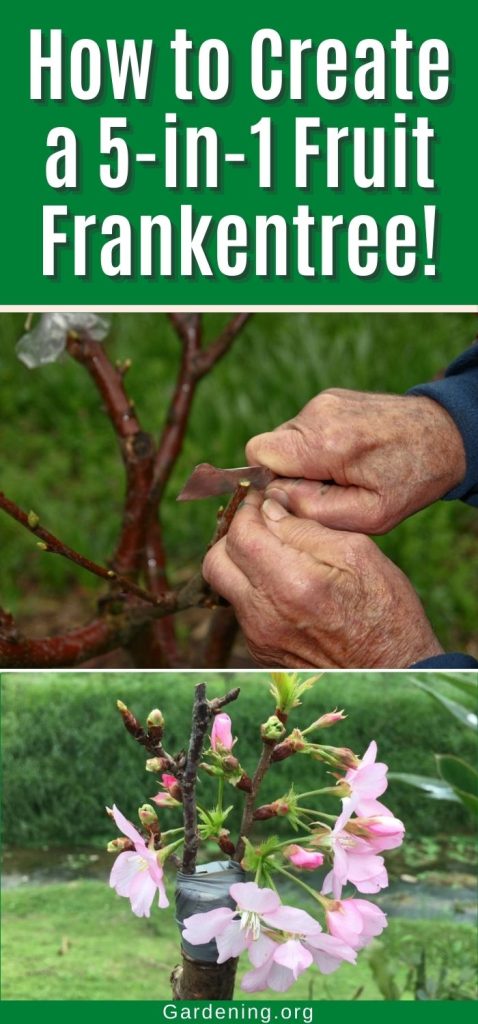
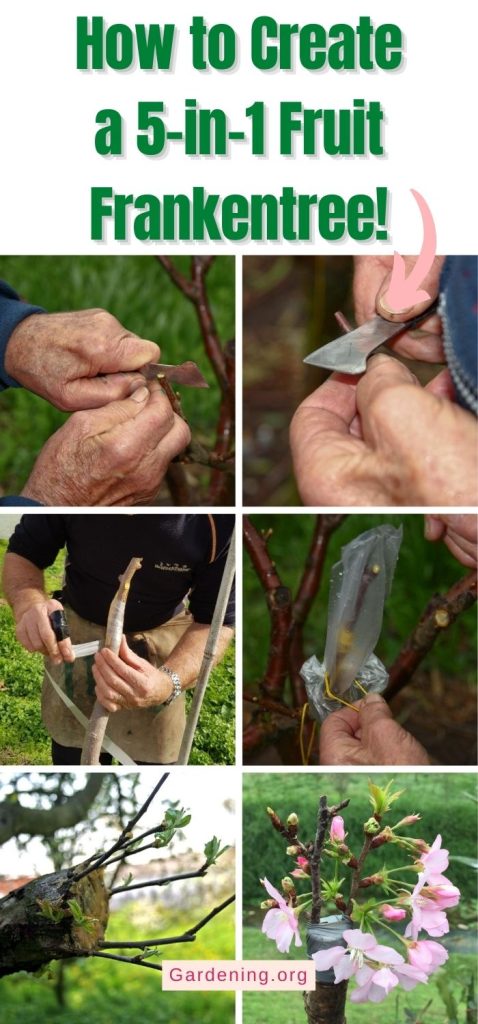
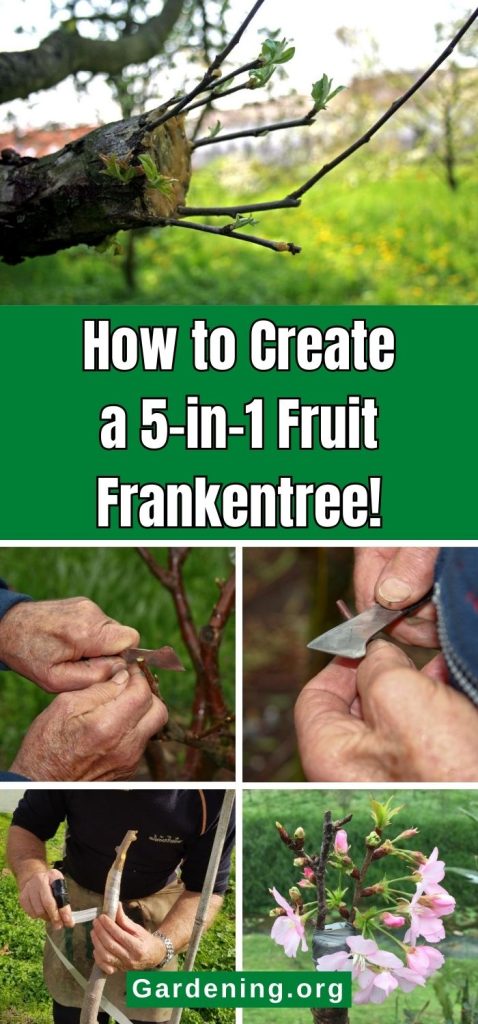
Why have one apple tree when you can have five apple trees in one? Or even more!
Say you’re nuts about fruit trees and you want to have a ton of them but you don’t have a lot of space. Perhaps you already have a few apple, pear, peach, or plum trees growing in your yard but you can’t add more.
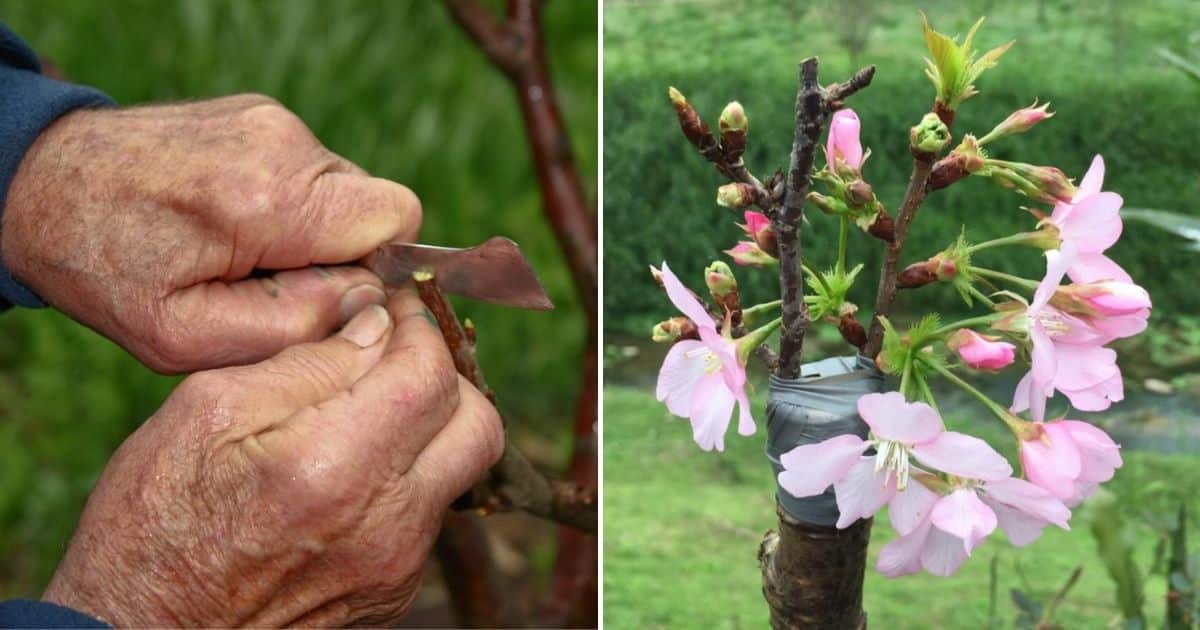
Well, if you know how to whittle, you can learn how to graft different fruit varieties onto your already-existing fruit tree. There’s a learning curve involved, and patience will be necessary. But here’s a primer about how to graft multiple fruit varieties onto your fruit tree and make a Frankentree!
I am mainly talking about apple trees here, but these techniques can be used with pear, peach, cherry, and plum trees, along with tropical fruit trees.
Jump to:
- The Benefit of Grafting a Frankentree
- A Quick Glossary for the Overwhelmed Beginner
- So Many Apple Varieties, So Little Time!
- How To Graft a Frankentree (Step By Step)
- 1. Gather Your Supplies
- 2. Match Scion to Branch (When Possible)
- 3. Cleave the Branch
- 4. Trim the Scion
- 5. Check the Fit of the Scion Over the Cut Branch
- 6. Have a Piece of Grafting Tape Ready
- 7. Waterproof the Cut (If Necessary)
- 8. Label the Scions
- 9. Cut Off the Buds on the End
- 10. Remove Any Fruit the Scions Set in the First Year
- 11. Cut Off Any Shoots That Grow from Below the Graft
- Scion Sources:
The Benefit of Grafting a Frankentree
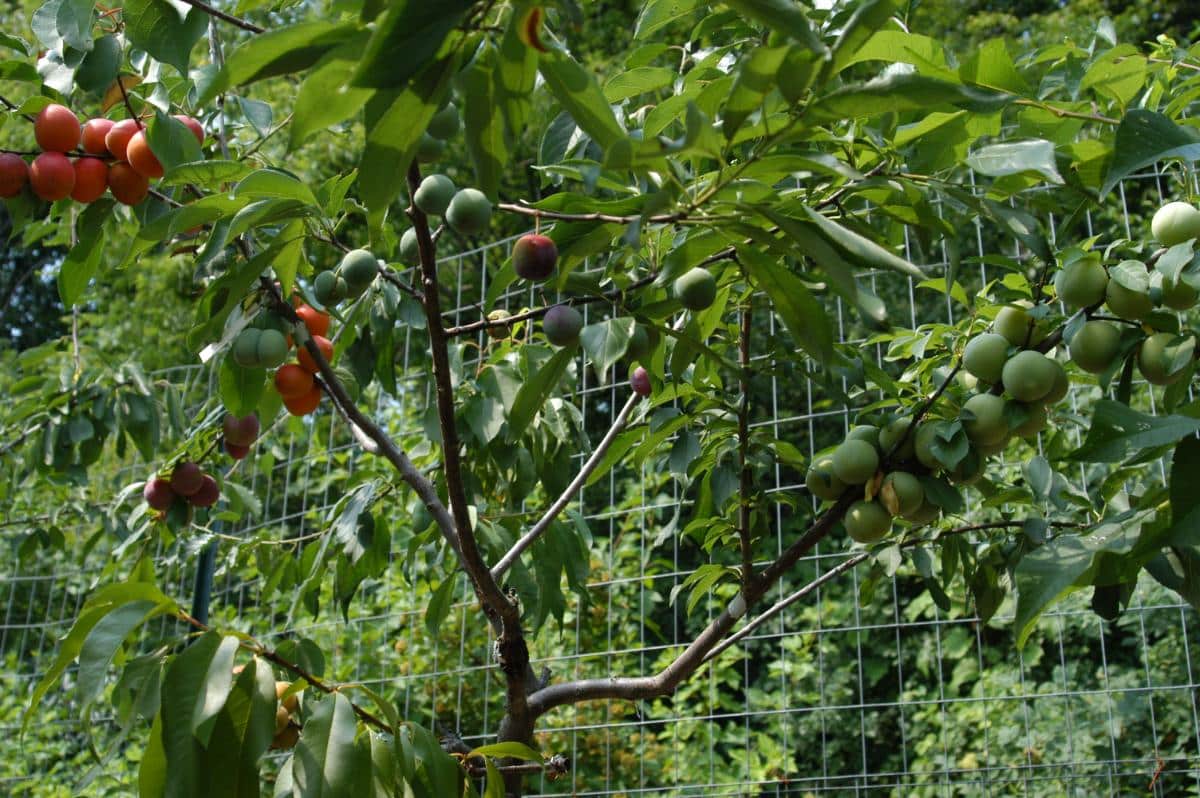
Adding scions to an existing tree is a great way to try a lot of different fruit varieties on one tree.
- It saves time. A young tree takes 2-5 years to grow old enough to bear fruit. However, a single branch will mature much more quickly.
- It saves space in a small yard – one tree instead of, say, 24.
- A multi-fruit tree looks cool, especially if it has different-colored blossoms or fruits ripening at the same time.
- It’s also a low-cost way to see how well unknown varieties survive in your climate. A fruit tree gets pricey, but a single scion costs from $3 to $14. Stick a scion on an existing apple tree and see how well it survives winters and sudden spring freezes, and taste the apples when they ripen.
- It improves pollination on existing fruit trees. Some trees are self-fertile, but many require a separate pollinator to get better-tasting apples and larger yields. A scion or two in flower will give your tree that extra boost that it needs.
A Quick Glossary for the Overwhelmed Beginner
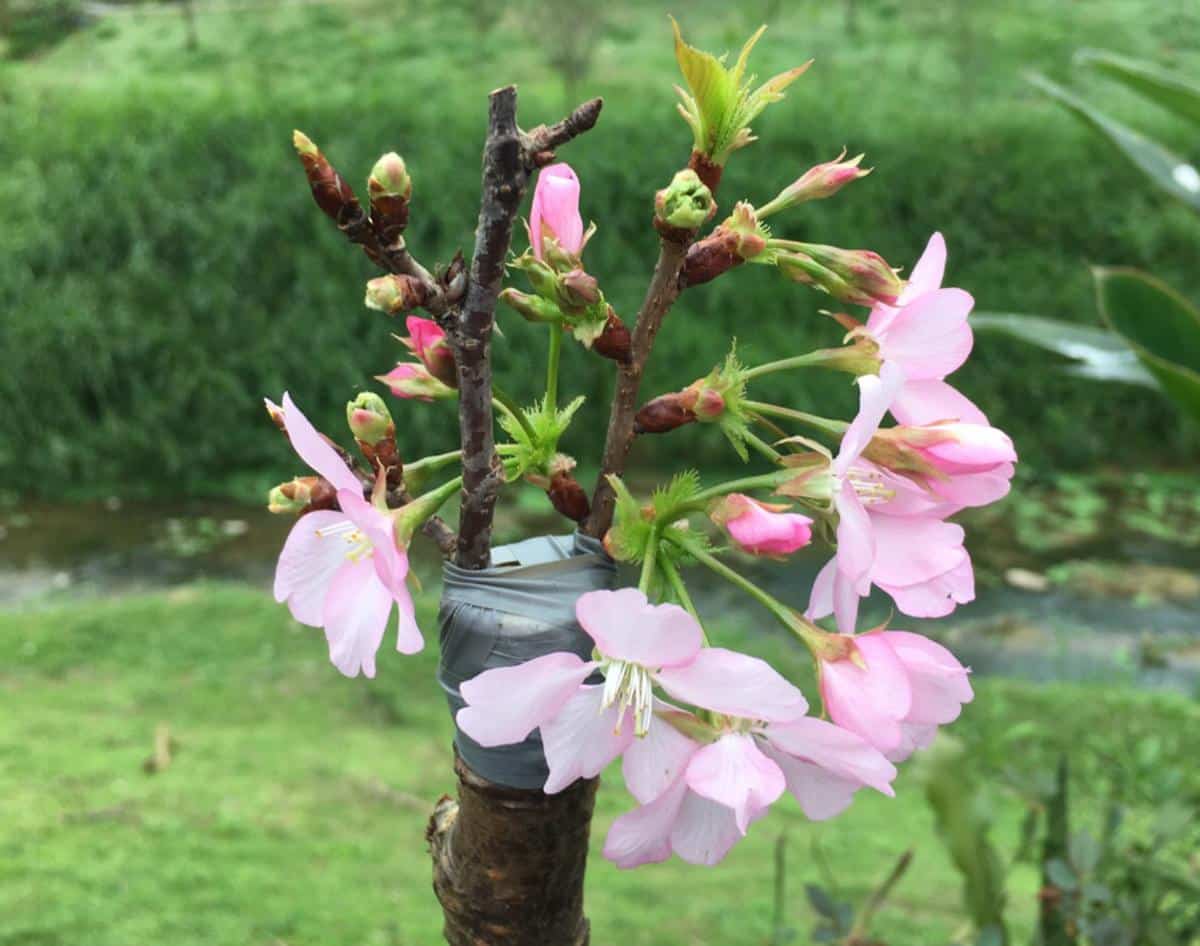
If this is your first time dipping your toe in the ocean of grafting, here are a few terms you’re going to run into pretty often.
Scion – A cutting of a woody tree or bush taken for propagation.
Rootstock – A stem with a developed root system onto which a bud or scion of a different plant is grafted. Rootstocks can transfer vigor, height (or lack thereof if it’s a dwarf rootstock), hardiness, and disease resistance to the variety that’s grafted onto it.
Dwarf – A tree that bears full-sized fruit that grows only half as tall as a full-sized tree. On fruit trees, that’s anywhere from 6-10 feet tall. Great for backyards and smaller spaces.
Semidwarf – Reaches about 75% of the height of a tree at full growth. Semidwarf trees are usually around 10-16 feet (it varies).
Standard – The full-sized tree that reaches its natural height. If left unpruned, standards can grow anywhere from 20 to 30 feet tall. They can live for 50 to 150 years or more if they’re left untouched by bulldozers or chainsaws.
Heirlooms – Heirloom fruit trees are old varieties that have often fallen out of commerce.
More Fruit Trees:
- 14 Basic Steps to Rejuvenate and Prune Apple Trees
- 7 Small Fruit Trees to Beautify Your Landscape
- How to Prune New Apple Trees for Best Fruiting
So Many Apple Varieties, So Little Time!
So let’s say some of us (i.e. me) are discovering some cool techniques that allow us to grow a lot of different fruit varieties in one place. And let’s say some of us are making up for years of lost time – I’ve ordered 9 scions already for next year!
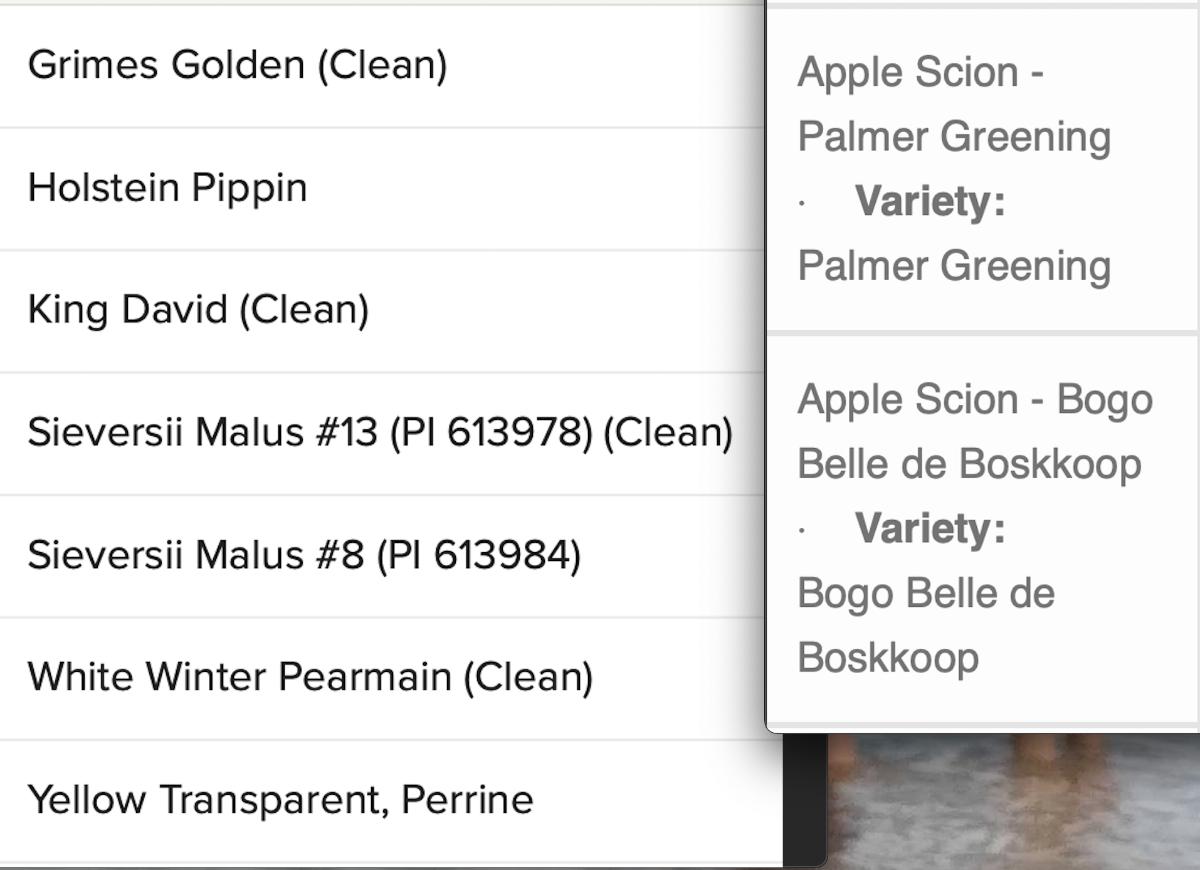
Orchards take scion orders starting in late fall and through the winter. Scions are generally delivered in early spring when fruit trees start waking up. Store scions in the fridge until you’re ready to graft them.
Stop grafting operations 10 weeks before the first frost so the trees have time to heal and the scions have a chance to harden off before the freezes hit.
How To Graft a Frankentree (Step By Step)
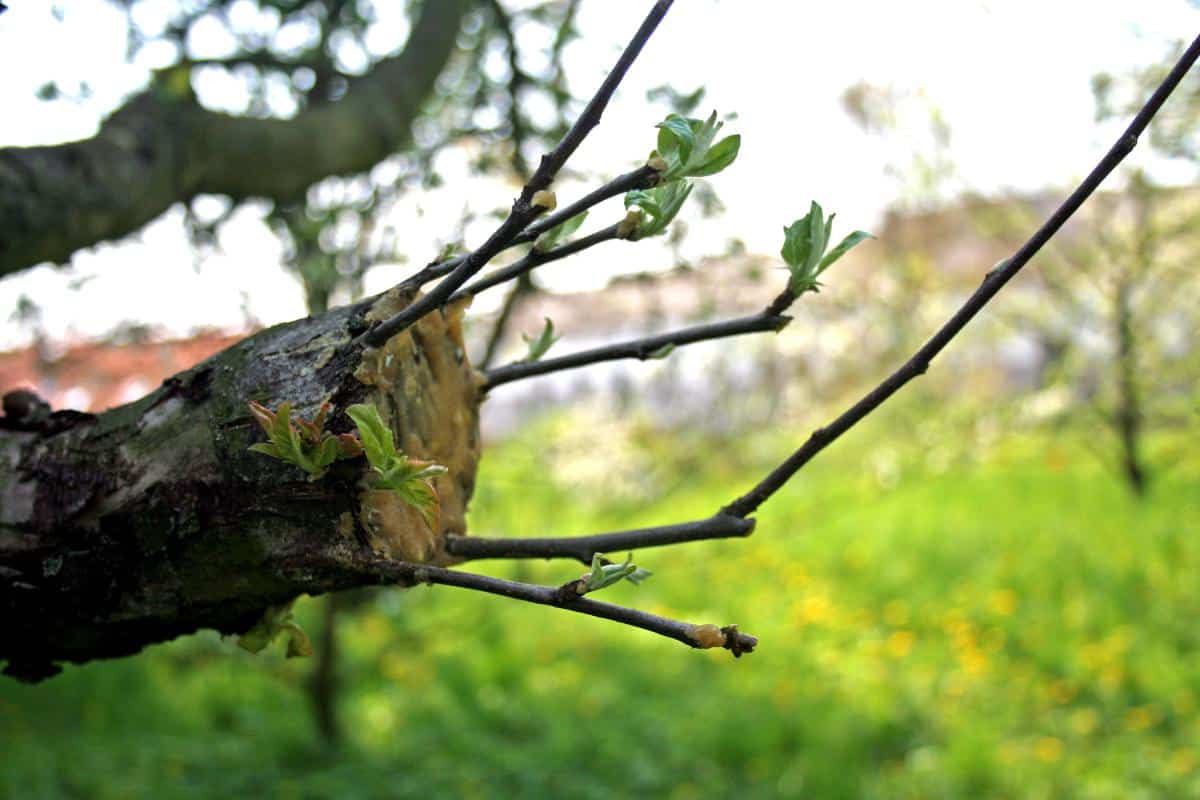
Scions should arrive in around early spring. While trees are still dormant, the sap is beginning to flow. If you haven’t grafted before, exercise caution (you are using a super-sharp knife, after all). Don’t get frustrated if your cuts don’t look like those of a professional orchardist. They’ve been doing this for a while and worked with hundreds of trees. A few grafts might not take, but you should be pleasantly surprised once the growing season gets underway.
1. Gather Your Supplies
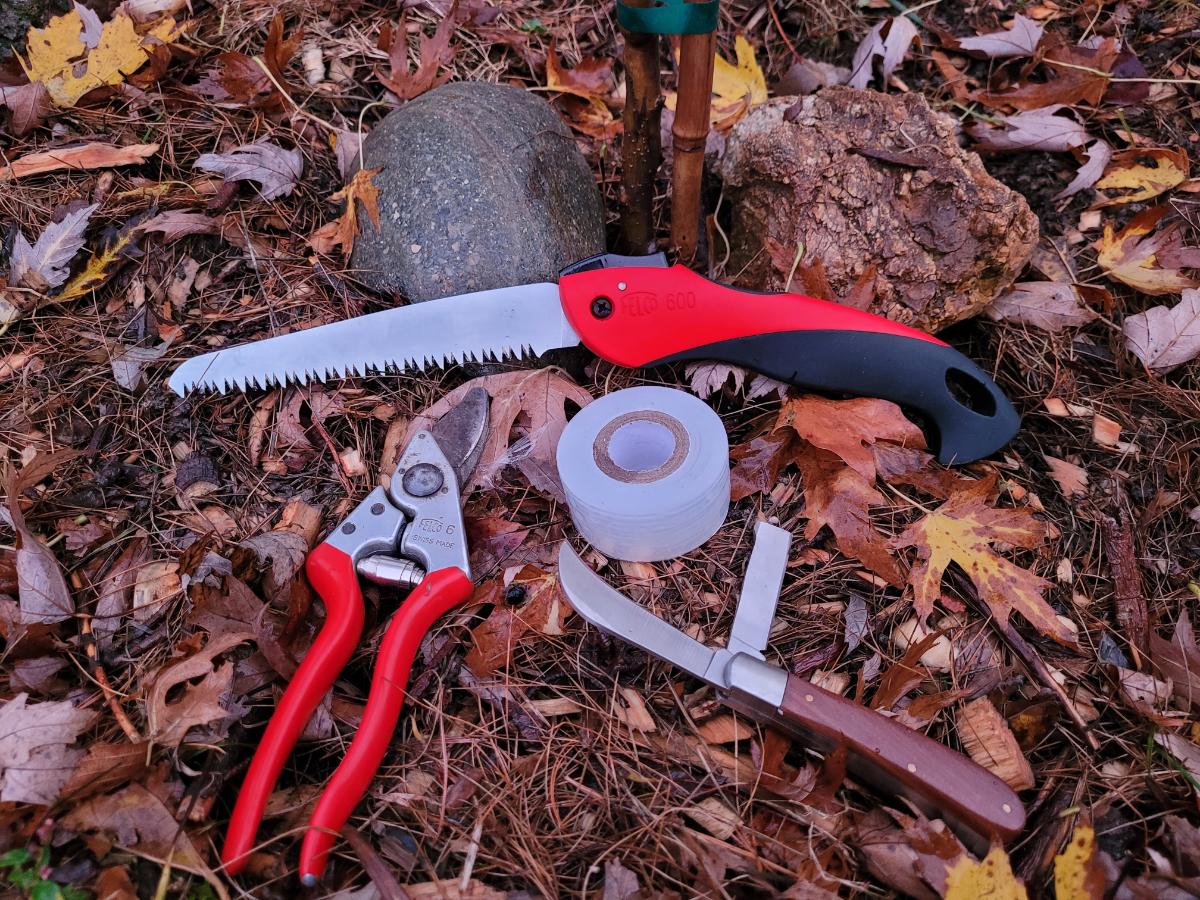
Have everything you need at hand before you start!
- Pruners
- Pruning saw (pocket saw is nice)
- Grafting tape, aka parafilm (any tape that stretches, including tie tape, flagging tape, budding tape)
- Grafting knife or a pocket knife (make sure it’s super-sharp)
- Some kind of sealant (grafting wax, latex paint, white glue, grafting seal)
- Tags (please tag scions so you know what you’ve put on the tree)
Protip: It’s not necessary to get expensive items if you’re just starting out (or even if you’ve been gardening for decades). Gardening is supposed to be a low-cost activity. Better Homes and Gardens ain’t going to come out and photograph you using old latex paint for sealant, and Home Beautiful won’t send you snarky messages if you use some leftover flagging tape on your grafts.
2. Match Scion to Branch (When Possible)
Hold your scions against various branches to find one that matches the scion’s width and bend. Then, snip off the original over an inch above where you plan to attach the scion.
The scion and the branch don’t have to match perfectly. A scion can be grafted to a limb larger than it is.
Place the scion on a branch that’s growing off the side of the main limb to give it additional support. Avoid putting them at the end of the branches so they don’t get cut off during winter pruning.
3. Cleave the Branch
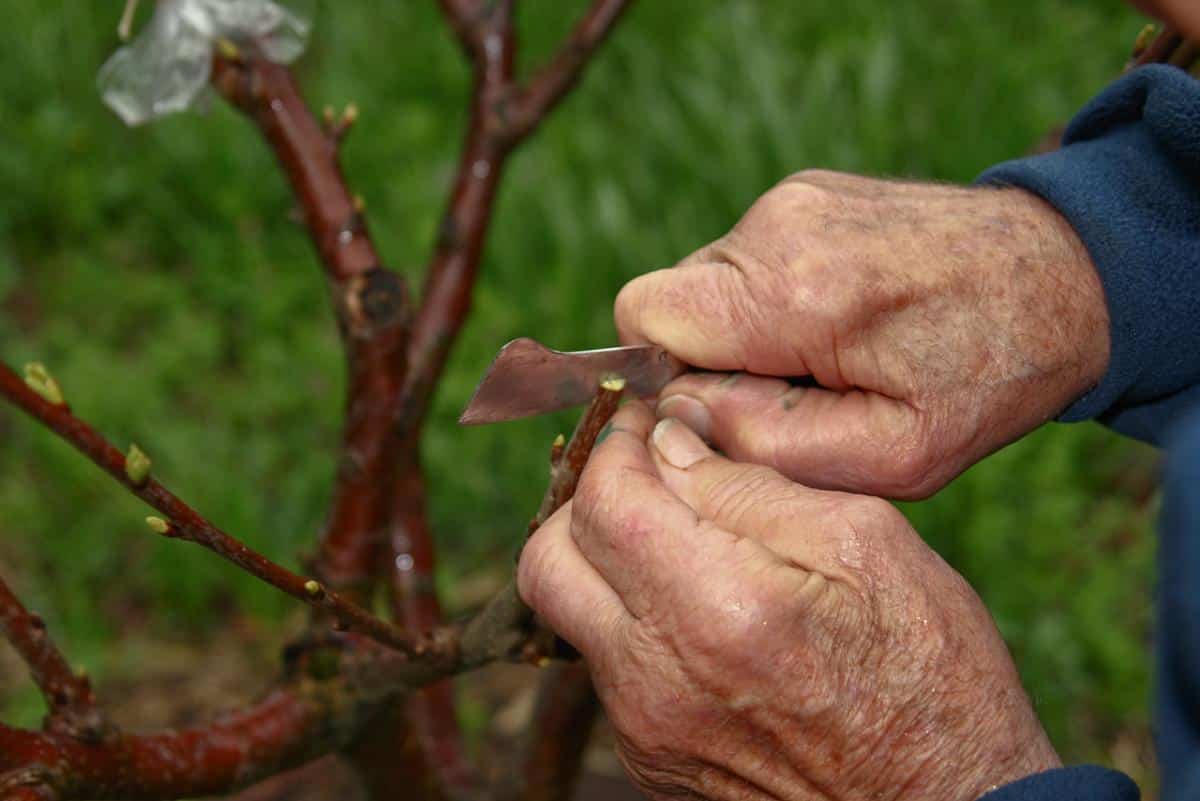
With a sharp knife, cut the branch to get a smooth cut. Please observe safety when doing this. If you haven’t done this before, practice on some other branches first to get the hang of it – you don’t want to spend time whittling away on the branch to get the perfect cut.
Keep the cut branch out of the sun to avoid desiccating the cambium layers.
4. Trim the Scion
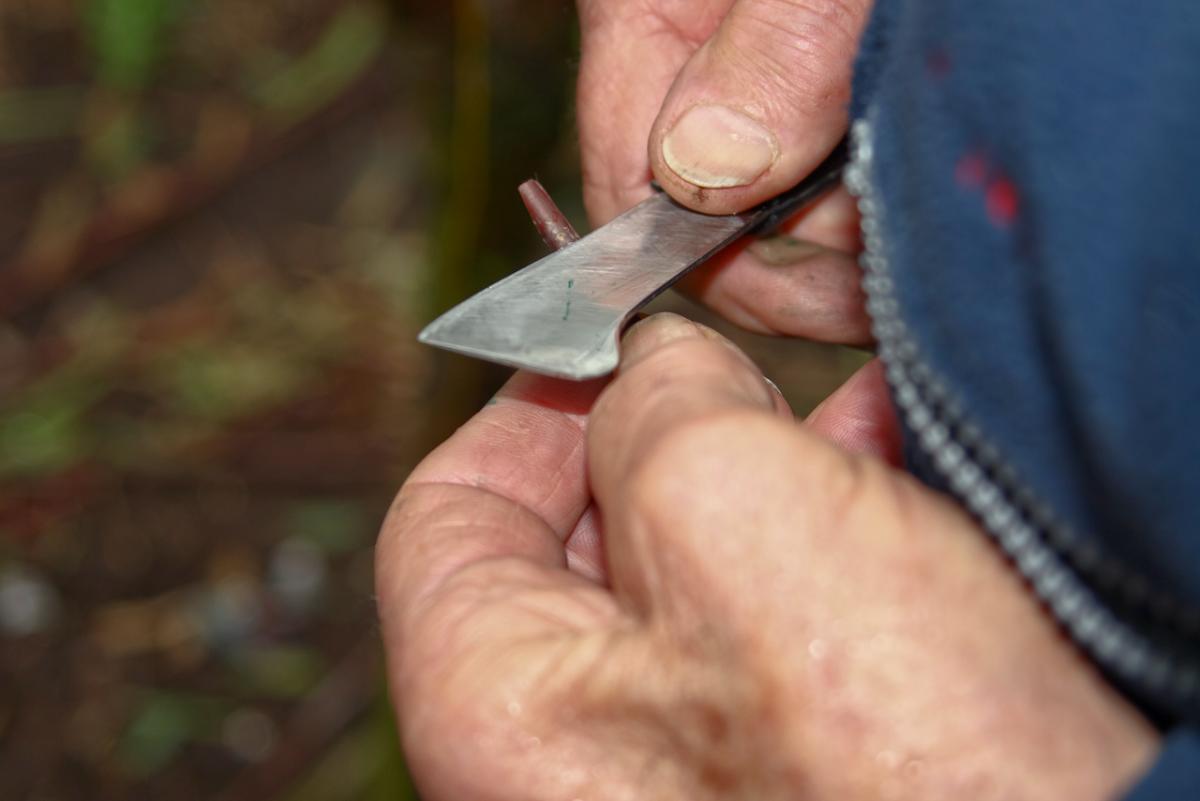
It’s okay to whittle this a little bit. Cut the scion at the same angle as the branch, getting as close to matching the size of the cut branch.
It’s slightly safer to lay the scion on your knee, hold the knife on the scion, and pull the scion toward you to make the cut.
5. Check the Fit of the Scion Over the Cut Branch
Lay the scion directly over the cut branch. Carefully adjust the sizes or angles of the cuts to make them as close to a fit as possible. The goal here is to have the cambium – the green growing parts of these – touch as much as possible on as many sides as possible. Don’t worry about making the perfect fit because trees are very forgiving. Match one side only.
More Grafting:
6. Have a Piece of Grafting Tape Ready
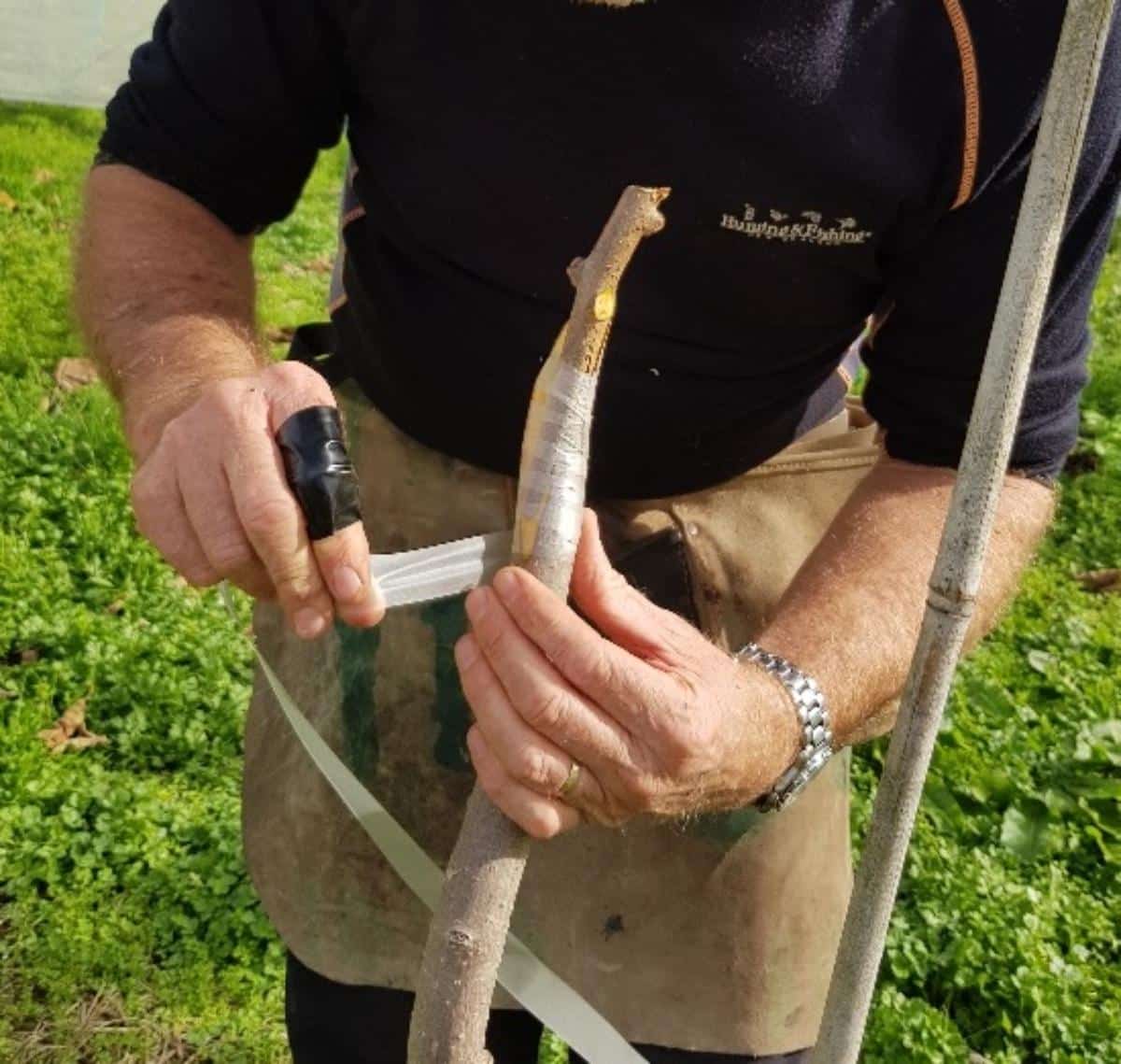
Stick a small piece of grafting tape or parafilm on your finger as you lay the two pieces atop each each other, then wrap the tape around them once they’re in place in order to hold them together and keep them aligned.
Pull the tape slightly, as if it’s florist’s tape, to hold it. You can see through the tape as well to make sure everything is lined up as you wrap it.
It’s extremely important to keep moisture in the scion as it’s growing onto its new home. Desiccation is the main cause of scion failure, especially in summer.
7. Waterproof the Cut (If Necessary)
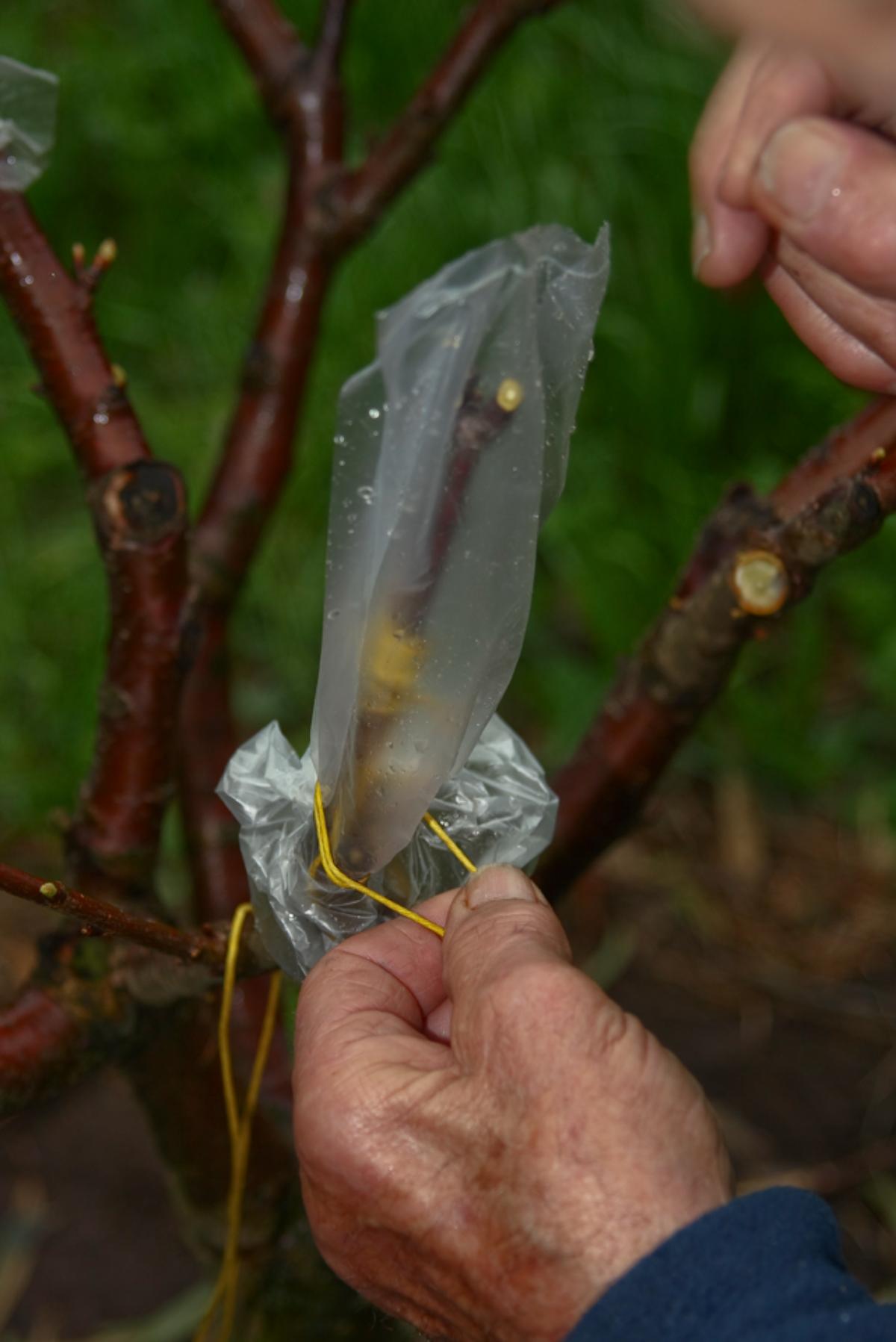
One way is to wrap the whole thing in a plastic bag. You can also wrap the grafting tape with electrical tape to keep it dry and hold it in place. Don’t wrap electrical tape directly on the bark, as it will pull it off. Lay it over the other tape. Add a tab on the end of the electrical tape to pull it off later.
8. Label the Scions
Use a piece of electrical tape to label the scion, or you will forget what it is.
Write the name on the electrical tape before attaching it to the tree. Or use a tag of some sort that can’t easily be pulled off.
A tree with lots of scions might be fluttering with so many twigs that they might be mistaken for leaves if they were green.
Be sure none of the tags girdle the tree branches. Loosen them a bit every year to keep ahead of branch growth.
9. Cut Off the Buds on the End
Make sure your scion has 3 or 4 buds (or more if possible), and then cut off the bud on the end to force it to branch out.
A longer scion, such as one that’s 10 inches long, can be cut in half, and then you have two scions to grow on your tree. If one fails, you still have the second one.
10. Remove Any Fruit the Scions Set in the First Year
I, too, want to grow fruit immediately on the new scions. However, any fruit should be removed in the first year so 1) the scion can direct all of its energy into growing, and 2) a heavy fruit on a young scion might cause it to break off the tree!
11. Cut Off Any Shoots That Grow from Below the Graft
These shoots are from the original plant and will rob energy from the new graft – and might even cause it to fail. Cut these off so the scion above the graft can grow unencumbered.
Scion Sources:
In Europe – EFNEX- European Fruit and Nut Explorers (on Facebook)
A complete list of scion sources from Growing Fruit, an online forum for orchardists
Read more gardening advice from Rosefiend Cordell.

Leave a Reply